
Bamboo Tattoo Thailand
Bamboo Tattoo in Thailand (Sak Yant & Hand‑poke) Traditionally done with a Bamboo Stick but now done with a Stainless Steel hygienic rod and grouped with first class needles.
What is a Bamboo Tattoo?
A bamboo tattoo in Thailand is a traditional hand‑poked method where the artist uses a bamboo stick with needles attached to manually tap ink into the skin. But today it is done with a stainless steel rod and machine needles attached to it. So it is totally clean and very accurate. Unlike machine tattoos, the process is quiet, meditative, and highly detailed.
This method has ancient roots tied to Ajarn (teacher) Sak Yant Masters and Buddhist teachings and old Southeast Asian spiritual traditions. Most people describe it as a much more personal and ceremonial experience.
So, what Is a Sak Yant Bamboo Tattoo in Thailand
A Sak Yant is a sacred Thai tattoo made traditionally by Sak Yant Ajarns (masters) and it contains:
Sacred geometry
Kata script
Symbolic animals
Protective blessings
These tattoos are believed to provide the wearer with a combination of protection, luck, strength, and spiritual benefits.
The most common Bamboo Tattoos in Thailand, Sak Yant designs include:
Hah Taew (5 lines) Sak Yant Bamboo Tattoo Thailand
Northern East Thailand Isan Hah Taew 5 Lines which has nothing to do with the Khmer Empire or Cambodia
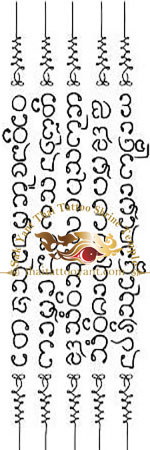
Hah Taew (5 lines) Sak Yant Bamboo Tattoo Thailand. Written in Kata Thai Script. Siam and Thai tattoo design
Buddha’s grace, Protection, Luck, Good Fortune, Kindness, Popularity, Attractiveness
The Hah Taew was immortalized forever when the actress, Angelina Jolie got it tattooed on her back. However, the Hah Taew has been traditionally very popular with men too.
The name when translated to English is “5 lines”.
This popular design is said to be one of the first Sak Yant tattoo a disciple should acquire.
It has a strong spiritual meaning and encompasses all aspects of a person’s life.
Each vertical line relates to a different area of one’s life and represents:
1st row: This avoids any type of unjust punishment and will also lean in your favour if there are any grey areas. It also represents the cleansing of negative spirits and protects the place where you live.
2nd row: Signifies the reversal and protection against any bad horoscope constellations including bad luck.
3rd Row: Viewed as protection against any types of black magic as well as preventing someone from putting a curse on you.
4th row: This row works to energize good luck, success & fortune in any future ambitions and your lifestyle.
5th row: As well as boosting the 4th row this final row works to enhance your charisma & attraction.
Yant Ha Taew is designed to improve your karma and destiny, gaining its power from the four elements, fire, water, air, and earth.
Popular in Thailand with both men and women, the five lines signify different areas of good fortune and health and is commonly worn on the shoulder or the base of the neck.
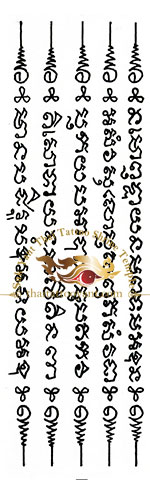
Bamboo Tattoo Thailand Chat Petch Sak Yant
Chad Petch Diamond Net Umbrella combined for Protection
Yant Takai Pedth
This design has a similar meaning to the Hah Taew Yant, but the “Chet Phet” enhances the power of the spells by interconnecting them.
The Five Diamond Tattoo (Good Luck and Fortune) is a traditional Thai tattoo also with five lines of yantras symbolizing magical spells.
Indeed, it has a similar meaning to the Yant Hah Taew; however the Yant Hah Petch is deemed more powerful due to the interconnection between all of the magical spells together and especially with regards to good Luck, fortune and wealth.
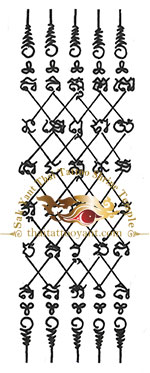
Paed Tidt (8 directions) Sak Yant Bamboo Tattoo Thailand
Paed Tidt 8 directions is a very interesting Bamboo Tattoo Thailand, a Sak Yant Thai tattoo. Many people like this one. It has been done many thousands of times at thaitattooyant.com with our original Sak Yant masters in our Sam Nak’s. (Shrine Temple to Sak Yant Tattoos) it is for travelling anywhere you want to go. You will be welcomed and protected by this yant who bear it on the body when travelling. It is a 8 directions compass for protection.
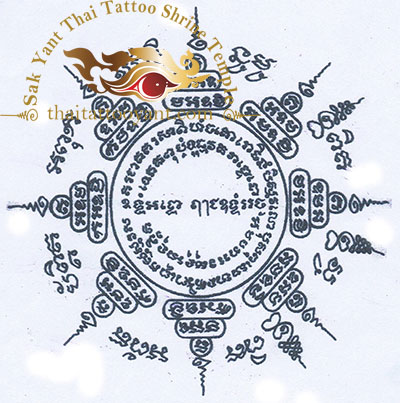
Gao Yord (9 spires) — the “master yant” for ultimate protection Sak Yant Bamboo Tattoo Thailand
In the English language this translates to “9 peaks” or “9 spires” and refers to the 9 peaks in the design.
The word “yord” is used in modern Thai to mean “the best” with the phrase “Sud Yord” being something you might hear if you’re in Thailand which means “amazing”.
In Buddhism the number 9 is of the highest importance and the Gao Yord is a representation of the 9 different Buddha’s and each one bestows special universal abilities, powers and spells.
The Gao Yord design is seen as a very potent tattoo which offers many wide-ranging powers of protection.
Most Sak Yant devotees see this as the highest sacred Buddhist tattoo.
This is the Master Yant which controls all other Yants and keeps the powerful ones under your control.
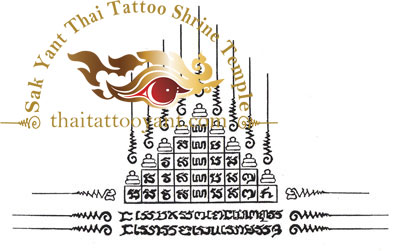
Gao Yord Mon Sak Yant Bamboo Tattoo Thailand
Gao Yord Mon (ยันต์เก้ายอดมอญ) is a specialized variation of the famous Gao Yord (Nine Spires) Sak Yant tattoo, specifically following the ancient Mon ethnic script and aesthetic traditions.
The Nine Spires: Just like the standard Gao Yord, the “nine peaks” represent the mythical Mount Meru, the center of the universe in Buddhist and Hindu cosmology.
The Mon Influence: While most Sak Yant use Kata script, the Gao Yord Mon utilizes Mon-style script, reflecting the deep historical influence of the Mon people on early Thai spirituality and tattoo traditions.
Universal Protection: Known as a “Master Yant,” it is typically the first tattoo a practitioner receives. It is believed to grant a wide range of blessings:
Maeta Ma Hah Niyom: Loving-kindness and popularity.
Kong Kra Phan: Invincibility and physical protection.
Klaeoklad: Evasion of danger or accidents.
Chana Satru: The ability to defeat enemies.
This sacred geometry is almost always placed high on the body, usually at the nape of the neck or the upper back. It must be performed by a qualified Sak Yant master
Gao Yord Morn or Mon
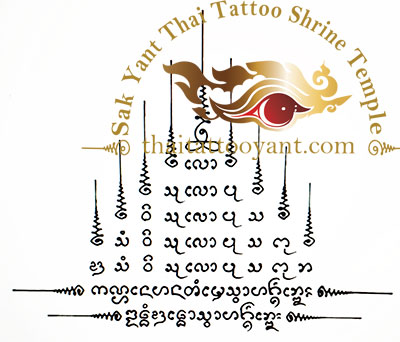
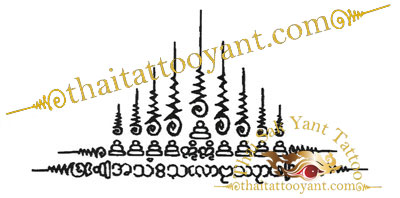
Symbolises strength, protection and avoidance of danger and harm.
The Yant Goa Yord Morn, also known as 9 Spires Yant is symbolic of magical powers said to bring protection and good luck to the bearer of this sacred tattoo. This design is similar to that of the Hah Taew Yant.
- Although it can be worn anywhere, typically, this design is tattooed at the nape of one’s neck. This Yant is symbolic of the Lord Buddha, with 9 images of him, demonstrating the importance of the number 9 in Buddhism. The 3 stacks of ovals that grow larger as they descend represent Buddha. There is also representation of the 9 Sacred Peaks of Mount Meru in its geometric design.
Yee Sib Gao Yord - 29 Spires Sak Yant Bamboo Tattoo Thailand
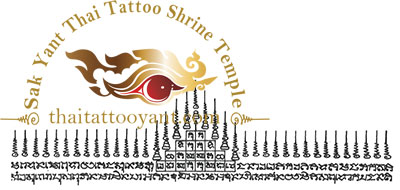
Yee Sib Gao Yord is an extension from the Yant Gao Yord (“yee sib gao yord” meaning “29 peaks”)
This yant allows you to enter into the lineage of masters, after which you will become a disciple and are then entitled to receive further yants with the protection of Yant Kroo (the Master Yant or Teacher).
This yant provides the wearer with magical protection and invincibility and shall ensure good luck in business and any other ventures in which the wearer is involved.
It will also assist the wearer to be more attractive to the opposite sex and help boost their charm.
It brings good luck and good fortune, improves one’s fate and will protect you against acts of violence.
This help to advance your circumstances at work and bless your life in many ways. 29 spires is the Master Yant or the Yant Khru, which holds dominance over all the other Yants, and this is the main design see below. This Yant provides protection, kindness, good luck and being popular.
The Yee Sib Gao Yord is an extension/expansion of the Yant Gao Yord which grants even further and increased protection with the ability to be untouchable.
Pra Ong Phra Chao Hah Sak Yant Bamboo Tattoo Thailand
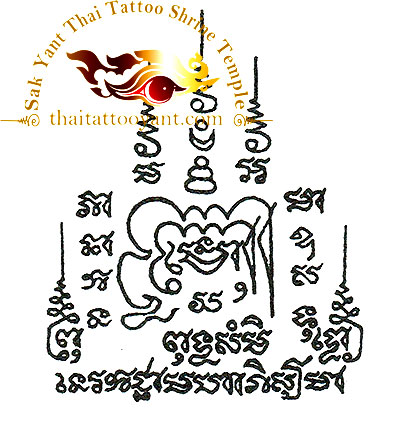
The Five Divine Kings Yantra (Pra Jao Ha Pra Ong)
The Five Divine Kings Yantra, also known as Pra Jao Ha Pra Ong, is one of the most sacred and powerful Maha Yant designs in Thai traditional tattooing (Sak Yant).
It represents the Five Buddhas of the current Bhadrakalpa (the auspicious eon), symbolizing the complete cycle of enlightenment across time. The yantra is deeply associated with the sacred mantra “Na Mo Phut Tha Ya” (Namo Buddhaya), which invokes the power of all five Buddhas.
Spiritual Meaning and Benefits
Core Virtues: This yantra encompasses the full spectrum of Buddhist blessings — protection from danger and misfortune, immense good fortune, loving-kindness (metta), prosperity, and invincibility.
Representation: It embodies the five historical and future Buddhas: Kakusandha, Konagamana, Kassapa, Gautama (Shakyamuni), and Maitreya.
Mantra: The incantation “Na-Mo-Put-Ta-Ya” is chanted during consecration and daily prayer to activate and maintain its power.
Status: Regarded as a “master yantra” or principal amulet, it is highly revered and popular among devotees of Sak Yant.
In practice, the Five Divine Kings Yantra is often tattooed in the form of a double Buddha image or as a symbolic representation of the Five Buddhas, with the exact design varying according to the lineage and teachings of each Sak Yant master (Ajarn).
This yantra is considered one of the highest-level protective and auspicious tattoos in Thai spiritual tradition.
Twin Tiger Suea Khroo Sak Yant Bamboo Tattoo Thailand
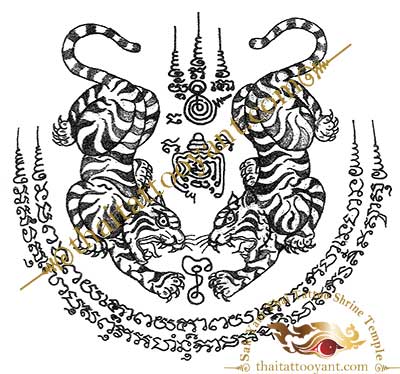
Sak Yant Thai Tattoo: Twin Tigers Yant (Suea Koo)
The Twin Tigers Yantra is one of the most popular and powerful designs in traditional Thai Sak Yant tattooing.
It symbolizes raw power, strength, authority, fearlessness, and dominance. The tiger is revered as the king of the jungle — a majestic and fearsome creature respected by all other animals. Wearing this Yant is believed to grant the wearer the same qualities: the ability to overcome challenges, command respect, protect oneself from danger, achieve victory, and rise into leadership positions.
Key Benefits and Meaning
Power & Protection: Grants strength, courage, and invincibility against harm.
Authority & Leadership: Helps the wearer gain influence and command respect from others.
Success in Competition: Highly favored by Muay Thai fighters, soldiers, and athletes for its ability to bring victory and dominance.
Business & Wealth: Many entrepreneurs and business owners choose this Yant because it is believed to bring success and advantage in negotiations and dealings.
The Twin Tigers design is considered even more potent than a single tiger, as two tigers together represent doubled power, just as two real tigers would dominate the jungle more effectively.
This Yant is typically depicted with two fierce tigers facing each other or standing side by side, with sacred Akara (Kata script) often placed below or surrounding the lower part of the design. It is a favorite choice for those seeking extra strength, confidence, and authority in their lives.
Bamboo Sak Yant Thai Tattoo: Hongsa / Golden Swan Yant (Hong Ku)
Also known as Pa Ya Hong Tong Twin Mythical Birds
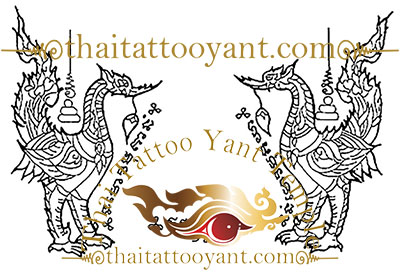
The Hongsa, also known as the Golden Swan, is a mythical bird resembling a graceful combination of a peacock and a swan. It is one of the most beautiful and meaningful designs in traditional Thai Sak Yant.
This Yant represents a previous incarnation of the Lord Buddha, when he was reborn as a magnificent Golden Swan living in the forest. According to ancient tales, the Golden Swan was so radiant and charismatic that all the other birds revered him as their natural leader.
One day, while swimming, the Golden Swan swam into a hunter’s trap. Instead of panicking or calling for help, he remained completely calm. With his final breaths, he warned the other animals not to approach the dangerous area and urged them to fly far away to safety. In a supreme act of selflessness and compassion, he sacrificed his own life to save countless others.
Spiritual Benefits of the Hong Ku Yant
Wearers of the Hongsa (Golden Swan) Yant are believed to receive the following blessings:
Charm and Eloquence — Exceptional oratory skills and the natural ability to persuade and convince others.
Popularity and Charisma — The power to attract people and be well-liked wherever they go.
Heightened Awareness — Sharp observational powers and strong intuition.
Self-Sacrifice & Kindness — The noble virtues of compassion, generosity, and selfless courage.
Beyond personal qualities, the Hongsa Yant also brings good fortune and prosperity. Because of its beauty and positive energy, it is extremely popular as a cloth Yant (Pha Yant) and is often seen hanging in shops, homes, and businesses for protection and auspicious blessings.
Sak Yant Thai Tattoo: Dok Bua Thong Flower (Bamboo Tattoo Golden Lotus Yant)
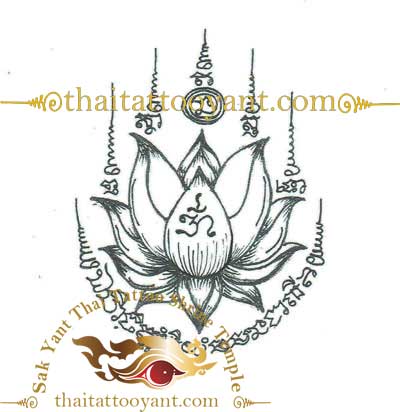
The Dok Bua Thong, or Golden Lotus Yantra, is a beautiful and highly auspicious design in traditional Thai Sak Yant tattooing. Done in Black or Red color.
The lotus flower is one of the most revered symbols in Buddhism. It grows from muddy water yet rises pure and untouched to bloom in perfect beauty — representing the journey of spiritual growth, purity, and enlightenment despite life’s challenges. The “golden” aspect adds the powerful energy of wealth, prosperity, and divine radiance.
Spiritual Meaning and Benefits
This Yant is especially popular for those seeking success in both personal and material life. It is believed to offer:
Love and Attraction — Strong charm (metta mahaniyom), popularity, and the ability to draw positive relationships and affection.
Good Luck and Fortune — Brings auspicious energy and success in all endeavors.
Success in Negotiations — Enhances persuasive communication, smooth dealings, and favorable outcomes in business or personal matters.
Spiritual Cleansing — Purifies the mind, body, and aura, promoting inner clarity, emotional balance, and wisdom.
Prosperity — Combines spiritual enlightenment with material abundance and positive growth.
Often combined with other elements such as the Hah Taew (Five Lines) or Unalome, the Dok Bua Thong is considered a powerful yet graceful Yant. It is favored by entrepreneurs, those in sales or public-facing roles, and anyone wishing to bloom beautifully through life’s difficulties while attracting love, luck, and success.
Because of its elegant appearance and positive energy, variations of the Golden Lotus are also commonly used as cloth Yant (Pha Yant) for homes and businesses.
Buddhism has a profound association with the Lotus flower and each colour has a various meaning:
Blue Lotus: Associated with victory of the spirit over, plus that of wisdom, intelligence & knowledge. Those who choose a Blue Lotus design will be given a depiction which is partially open, but the centre is never displayed.
White Lotus: As can be well imagined, purity plays its part in this design. The white lotus flower represents Bodhi (being awakened). This symbolises a state of mental purity and relates to spiritual perfection. A white lotus also associates with the calming of a person’s nature and in this design, it is considered to be the womb of the world.
Purple Lotus: A purple lotus is viewed as being Mystic and having an association with esoteric sects. Designs choices are seen as an open flower or a bud. The 8 petals symbolise the noble eightfold path which is a principal Buddhist teaching. By following this course it will lead to self-awakening and is considered as one of the noble truths.
Pink Lotus: Regarded as the supreme lotus and seen to be the true lotus of the Buddha.
Red Lotus: Red associates to the heart, so this design relates with love & compassion.
Sak Yant Thai Tattoo: Yant Pee Sue Ladree (Bamboo Tattoo Butterfly Yant)
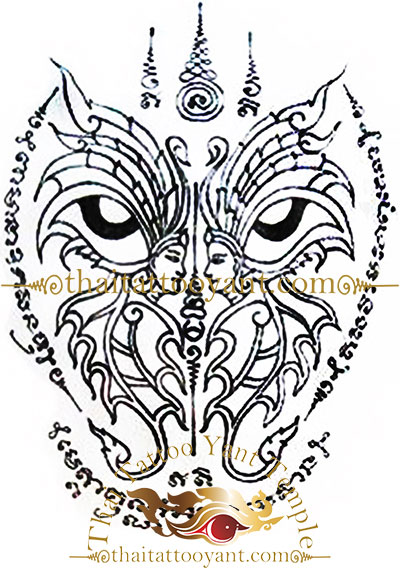
The Yant Pee Sue Ladree, also known as the Butterfly Yantra, is a graceful and highly attractive design in traditional Thai Sak Yant tattooing. “Pee Sue” refers to a butterfly, and “Ladree” (or variations like Thepjumlang) adds a layer of divine or angelic energy. The butterfly symbolizes transformation, lightness, beauty, and the ability to draw positive attention — much like how a butterfly naturally captivates everyone around it. This Yant is especially popular among people in the entertainment industry, including singers, musicians, actors, actresses, and public performers, as well as anyone who wants to enhance their personal magnetism. Spiritual Meaning and Benefits Wearing the Pee Sue Ladree Yant is believed to grant: Charm and Attraction (Metta Mahaniyom) — Strong personal magnetism that makes the wearer more likable, persuasive, and appealing to others. Popularity and Success in Entertainment — Boosts fame, fan support, and opportunities in creative or public-facing careers. Transformation and Grace — Helps the wearer navigate life’s changes with ease, beauty, and emotional balance. Divine Magnetism — Infused with Thepjumlang (angelic/divine power), it draws prosperity, favorable opportunities, and positive relationships. Emotional Elegance — Promotes a light, charismatic presence that inspires admiration and goodwill. The design often features a beautiful butterfly with delicate wings, sometimes combined with sacred Khom script or other auspicious elements. Its elegant appearance makes it visually striking while carrying powerful spiritual energy for attraction and success. Because of its strong association with charm and popularity, the Butterfly Yant is a favorite choice for those seeking to shine in social, artistic, or business environments. |
Sak Yant Thai Tattoo: Yant Ling (Bamboo Tattoo Monkey Yant)
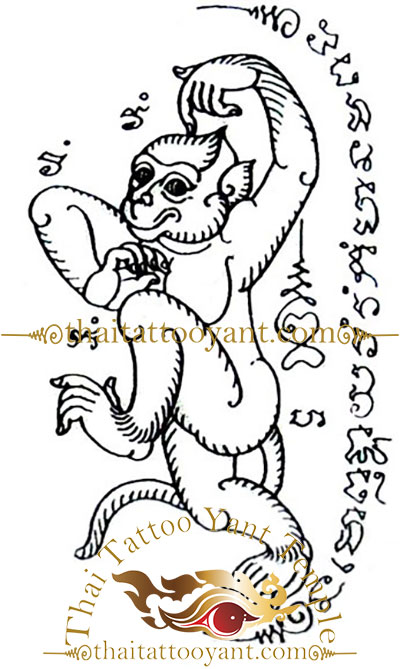
The Sak Yant Ling, also known as the Monkey Yantra, is a dynamic and clever design in traditional Thai Sak Yant tattooing.
In Thai, “Ling” simply means monkey. This Yant draws from the playful, intelligent, and agile nature of monkeys in both nature and Thai mythology (particularly the monkey warriors in the Ramakien epic). The monkey symbolizes mischief balanced with sharp wit, adaptability, and a light-hearted approach to life’s obstacles.
Unlike the more powerful and rare Sak Yant Ling Lom (Wind Monkey), which emphasizes supernatural speed and evasion, the standard Sak Yant Ling focuses on everyday cunning, curiosity, and joyful freedom. It reminds the wearer to stay flexible, creative, and spontaneous while navigating challenges with intelligence rather than brute force.
Spiritual Meaning and Benefits
Wearing the Sak Yant Ling is believed to grant:
Intelligence and Quick Wit — Enhanced problem-solving skills, clever thinking, and the ability to find creative solutions.
Agility and Adaptability — Physical and mental flexibility to pivot quickly in difficult situations, travel, negotiations, or daily life.
Charm and Playfulness — A light, charismatic energy that brings joy, spontaneity, and a playful spirit (often described as “benevolent mischief”).
Freedom and Curiosity — Courage to break routines, explore new paths, and embrace life with a sense of adventure and connection to nature.
Luck and Positive Energy — Attraction of good fortune through sharp instincts and an adaptable mindset.
This Yant is especially popular among those who value mental sharpness, creativity, and the ability to “dance” through life’s ups and downs — such as artists, entrepreneurs, travelers, performers, or anyone seeking more fun, adaptability, and clever success.
The design usually features a lively monkey in dynamic poses, often with sacred Katha script (Akara) surrounding or integrated into the image for added power.
Muay Thai Fighter
Sak Yant Thai Tattoo: Yant Nai Khanom Tom (Bamboo Tattoo Khanom Tom Yant)
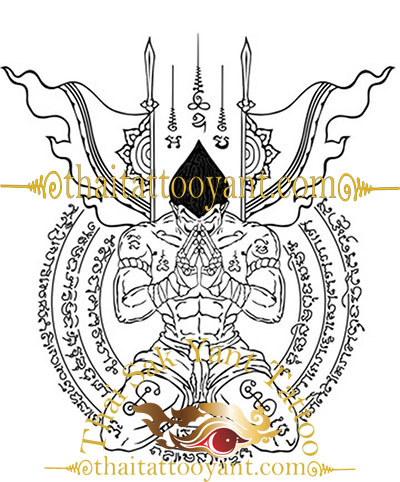
The Yant Nai Khanom Tom, also known as the Khanom Tom Yantra, is a powerful and inspiring design in traditional Thai Sak Yant tattooing.
It honors Nai Khanom Tom (นายขนมต้ม), the legendary Muay Thai warrior from the Ayutthaya period, widely revered as the Father of Muay Thai. According to Thai legend, while held captive in Burma, Nai Khanom Tom defeated ten Burmese champions in succession using only his bare hands and traditional Thai boxing techniques — showcasing unmatched skill, courage, and indomitable spirit. His victories not only secured his freedom but also helped spread the fame of Muay Thai across the region.
This Yant captures the essence of the true warrior: discipline, resilience, fearlessness, and the perfect blend of physical prowess with mental focus.
Spiritual Meaning and Benefits
Wearing the Yant Nai Khanom Tom is believed to grant:
Strength and Endurance — Exceptional physical power, stamina, and the ability to push through exhaustion in combat, sport, or daily challenges.
Courage and Fearlessness — Unshakable bravery and confidence, both in the ring and in life’s battles.
Agility and Speed — Quick reflexes, sharp technique, and the ability to outmaneuver opponents or obstacles.
Mental Focus and Discipline — Heightened concentration, strategic thinking, and unwavering determination.
Protection and Victory — Invincibility against harm, safeguarding from danger, evil spirits, and negative forces, while attracting success and triumph.
Warrior Spirit — Deep respect for tradition, teachers (Kru), and the noble path of the fighter.
This Yant is especially popular among Muay Thai fighters (Nak Muay), martial artists, soldiers, athletes, and anyone seeking inner strength, comeback energy, or dominance in competitive fields. It serves as a spiritual anchor for those facing tough challenges or striving for victory through discipline and heart.
The design typically features a fierce depiction of Nai Khanom Tom in a fighting stance or symbolic warrior form, surrounded by sacred Khom script (Akara) and powerful incantations that amplify its protective and empowering energy. Many versions combine it with other elements like Twin Tigers or Naga for even greater potency.
Sak Yant Thai Tattoo: Yant Jorakhae (Bamboo Tattoo Crocodile Yant)
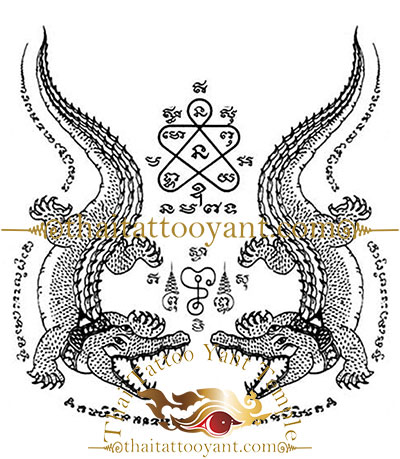
The Yant Jorakhae, also known as the Crocodile Yantra (or sometimes called Yant Phaya Kumphi / Thaerawad), is a powerful and ancient design in traditional Thai Sak Yant tattooing. The crocodile is one of the oldest surviving creatures on Earth, symbolizing primordial strength, endurance, patience, and unyielding resilience. In Thai mythology and Himmapan lore, the sacred crocodile represents a formidable guardian that thrives in both water and land, embodying adaptability, strategic power, and an armored defense that is nearly impenetrable. This Yant is especially favored by those in high-risk professions — such as Muay Thai fighters, soldiers, police officers, firefighters, and security personnel — because of its reputation for granting unbreakable protection and warrior-like fortitude. Spiritual Meaning and Benefits Wearing the Yant Jorakhae is believed to grant: Immense Strength and Endurance — Physical and mental toughness to withstand hardship, pain, and long battles. Powerful Protection (Kong Krapan) — Invincibility against weapons, blades, piercing injuries, accidents, and physical harm. It is said to make the skin as tough as crocodile hide. Vigilance and Awareness — Heightened intuition to detect danger, deceit, manipulation, or hidden threats before they strike. Patience and Strategic Power — The ability to wait for the perfect moment, move with calculated force, and never retreat (crocodiles famously cannot walk backwards, symbolizing forward momentum only). Adaptability and Survival — Resilience in any environment or crisis, thriving through change while remaining dominant. Defense Against Evil — Protection from black magic, negative energies, and spiritual attacks. Some versions, particularly the Twin Crocodile design, add layers of balance, teamwork, mutual support, and harmony between strength and wisdom. The design typically features one or two fierce crocodiles in dynamic or coiled poses, often with sacred Khom script (Akara) integrated around or within the body for maximum power. Its raw, ancient energy makes it visually striking and spiritually potent. And blessings, chants in Kata. Because of its strong protective qualities and association with survival in dangerous situations, the Crocodile Yant remains a favorite for those seeking unshakeable strength, fearlessness, and the ability to overcome life’s toughest challenges. |
Sak Yant Thai Tattoo: Yant Payanag (Bamboo Tattoo Nagaraj / Phaya Naga Yant)
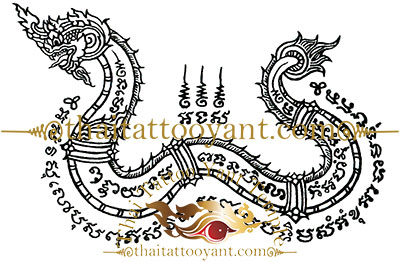
The Yant Payanag, also known as Yant Nagaraj or Phaya Naga Yantra, is a majestic and highly revered design in traditional Thai Sak Yant tattooing, especially popular in Lanna (Northern Thai) tradition.
“Payanag” (or Payanak) refers to the Great Naga — the mythical serpent king (Nagaraj) that features prominently in Buddhist, Hindu, and Thai folklore. The Naga is a powerful, semi-divine being associated with water, rain, fertility, and the protection of sacred teachings. It is often depicted as a multi-headed serpent or dragon-like creature that guards treasures, temples, and the Buddha himself (most famously sheltering the Buddha during a storm).
This Yant invokes the immense spiritual power of the Naga King, symbolizing the balance between earthly power and divine wisdom.
Spiritual Meaning and Benefits
Wearing the Yant Payanag is believed to grant:
Protection and Guardianship — Strong safeguarding from danger, harm, accidents, black magic, and negative energies. The Naga acts as a fierce protector for the wearer.
Wealth and Prosperity — Attraction of abundance, good fortune, unexpected luck, and material success. The Naga is traditionally a guardian of hidden treasures and riches.
Power and Strength — Inner and outer power, resilience, and authority, especially in challenging situations.
Wisdom and Intuition — Heightened spiritual insight, emotional balance, intuition, and connection to higher realms or sacred knowledge.
Purification and Transformation — Cleansing of negative influences, personal growth, regeneration, and the ability to flow gracefully through life’s changes (like water).
Peace and Good Fortune — A harmonious life filled with happiness, popularity, and blessings wherever one goes.
The design is often intricate, featuring a majestic Naga (sometimes multi-headed) coiled or rising, combined with powerful Khom script (Akara) and sacred yantra elements for maximum potency. It is especially favored by those seeking success in business, spiritual growth, protection in risky professions, or a deeper connection to divine forces.
Because of its association with wealth, strength, and sacred protection, the Payanag Yant is considered one of the more potent designs for attracting both material and spiritual abundance while maintaining balance and responsibility.
Sak Yant Thai Tattoo: Yant Soysungwarn (Bamboo Tattoo Necklace / Soy Sung Warn Yant)
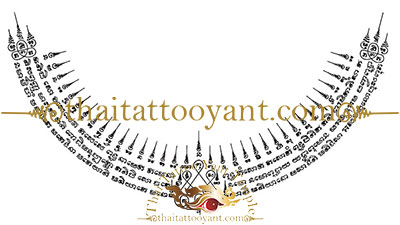
The Yant Soysungwarn, also known as the Necklace Yantra or Yant Sroi Sangwan, is a powerful and elegant design in traditional Thai Sak Yant tattooing.
Its name translates to “sacred necklace” or “divine chain,” and the design resembles an ornate, protective collar or necklace worn across the chest or around the collarbone area. In ancient times, Siamese warriors would tattoo or wear this Yant as spiritual armor to safeguard themselves in battle.
This Yant symbolizes invulnerability, unbreakable protection, and the wearer’s ability to command respect while remaining shielded from harm — much like a mystical necklace that encircles and fortifies the body and spirit.
Spiritual Meaning and Benefits
Wearing the Yant Soysungwarn is believed to grant:
Invulnerability (Kong Krapan) — Powerful protection against weapons, blades, piercing injuries, physical attacks, and accidents. It is especially renowned for safeguarding the neck, chest, and vital areas.
Strength and Power — Inner resilience, courage, and the fortitude of a warrior.
Kindness and Metta — Enhanced loving-kindness, charisma, and the ability to gain goodwill from others.
Protection from Danger — Defense against harm, evil forces, black magic, and misfortune.
Authority and Respect — Natural leadership presence and the ability to command respect in any situation.
This Yant is particularly popular among Muay Thai fighters, soldiers, police officers, and anyone in high-risk or competitive professions who seek unbreakable protection and warrior-like strength. Many also choose it for its balanced energy that combines raw power with kindness and personal magnetism.
The design typically features intricate, flowing lines resembling a sacred chain or necklace, often interwoven with powerful Khom script (Akara) and yantra elements for maximum spiritual potency. It is commonly placed across the upper chest or collarbone, where it acts as a visible and energetic shield.
Because of its ancient warrior origins and reputation for making the body resistant to harm, the Yant Soysungwarn remains one of the most respected protective designs in Sak Yant tradition.
Sak Yant Thai Tattoo: Yant Thao Vessavaana (Bamboo Tattoo Thao Wessuwan / God of Giants Yant)
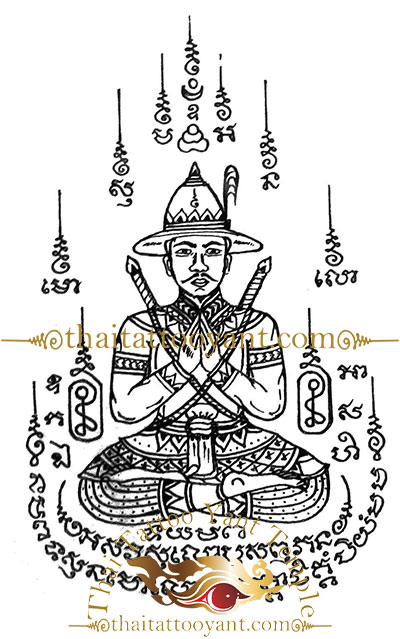
The Yant Thao Vessavaana, also known as Yant Thao Wessuwan or Yant Phaya Wessuwan, is a powerful and majestic design in traditional Thai Sak Yant tattooing.
Thao Vessavaana (or Vessavana) is one of the Four Heavenly Kings (Thao Chatulokaban) in Buddhist cosmology. He is the guardian of the Northern direction, the God of Giants (Yaksha), and the revered God of Wealth. In Thai tradition, he is depicted as a fierce yet benevolent giant warrior who protects the human realm from evil forces, ghosts, demons, and misfortune while bestowing riches and good fortune.
This Yant invokes the divine authority and protective power of Thao Vessavaana, symbolizing unshakeable strength, spiritual guardianship, and the transformation of negative energy into prosperity.
Spiritual Meaning and Benefits
Wearing the Yant Thao Vessavaana is believed to grant:
Powerful Protection — Strong shielding from danger, black magic, evil spirits, demons, ghosts, and all forms of harm. It frightens away negative entities and creates an invisible armor around the wearer.
Wealth and Prosperity — Attraction of riches, good fortune, business success, and financial abundance. As the God of Wealth, Thao Vessavaana helps “attract money to flow in” and turns misfortune into opportunity.
Strength and Authority — Immense inner and outer power, courage, leadership presence, and the ability to overcome enemies or obstacles in all areas of life.
Good Luck and Success — Enhanced luck, career promotion, popularity, and the fulfillment of wishes in the near future.
Spiritual Power — Divine blessings, protection of the Northern direction, and the ability to live with dignity, respect, and positive energy.
This Yant is especially popular among entrepreneurs, business owners, those seeking financial growth, and anyone needing strong protection in risky or competitive environments. It is considered an “all-purpose” Maha Yant for those who want both material success and spiritual safeguarding.
The design typically features a fierce, imposing figure of Thao Vessavaana in a warrior stance (often holding a weapon or treasure), surrounded by sacred Khom script (Akara) and powerful yantra elements that amplify its potency.
Because of its deep roots in Buddhist mythology and its reputation for delivering both wealth and unbreakable protection, the Yant Thao Vessavaana remains one of the most respected and sought-after designs for those desiring divine strength and prosperity.
Sak Yant Thai Tattoo: Yant Mangkorn (Bamboo Tattoo Dragon Yant)
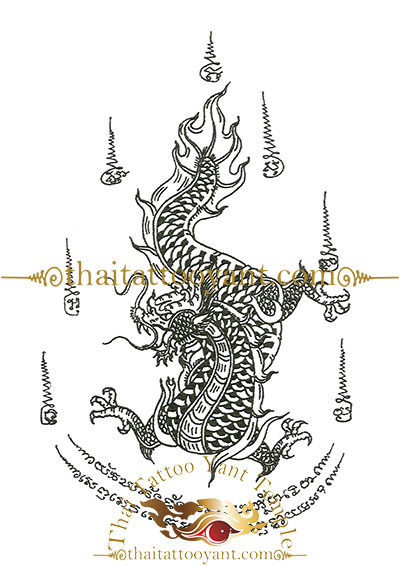
The Yant Mangkorn, also known as the Dragon Yantra, is a majestic and highly potent design in traditional Thai Sak Yant tattooing.
In Thai, “Mangkorn” means dragon — a powerful mythical creature drawn from Buddhist, Hindu, and Himmapan forest legends. The dragon (sometimes blending with Naga serpent imagery) is revered as a fire-breathing guardian of immense strength, wisdom, and celestial power. It symbolizes transformation, dominance over obstacles, and the ability to rise above challenges with fierce grace.
This Yant channels the dragon’s raw elemental energy, making it one of the most visually striking and spiritually commanding designs in Sak Yant tradition.
Spiritual Meaning and Benefits
Wearing the Yant Mangkorn is believed to grant:
Powerful Protection — Strong safeguarding from physical harm, weapons, accidents, bad fortune, negative influences, and harmful energies (both seen and unseen).
Strength and Courage — Unshakable inner power, bravery, confidence, and resilience to overcome enemies or life’s difficulties.
Wisdom and Authority — Heightened intelligence, strategic thinking, leadership presence, and the ability to command respect and control situations.
Good Fortune and Success — Attraction of prosperity, good luck, business success, and positive opportunities. The dragon’s fire is said to burn away obstacles and transform misfortune into victory.
Transformation and Spiritual Power — Personal growth, the ability to evolve through challenges, and a deeper connection to higher realms or divine energy.
This Yant is especially popular among Muay Thai fighters, military personnel, government officials, entrepreneurs, and anyone seeking dominance in competitive fields or protection in dangerous situations. It is considered an excellent all-rounder for those who want both raw power and wise guidance.
The design typically features a fierce, dynamic dragon with scales, flames, claws, and flowing body lines, often integrated with sacred Khom script (Akara) for added potency. Some versions show the dragon breathing fire or in a protective coiled stance.
Because of its fearsome reputation and ability to inspire awe and respect, the Yant Mangkorn remains a favorite for those desiring unbreakable strength, spiritual elevation, and success in all endeavors.
Sak Yant Thai Tattoo: Yant Chang Sam Sien (Three-Headed Elephant / Erawan Yant)
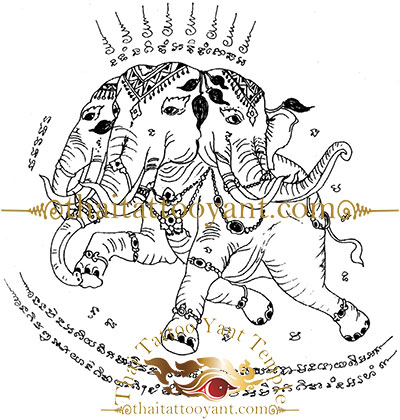
The Yant Chang Sam Sien, also known as the Three-Headed Elephant Yantra or Erawan Yant, is a majestic and powerful design in traditional Thai Sak Yant tattooing.
“Chang Sam Sien” translates to “Elephant with Three Heads.” It represents Phraya Erawan (Airavata in Hindu tradition), the divine three-headed elephant who serves as the mount of the god Indra. In Thai-Buddhist and Hindu mythology, Erawan is the king of all elephants — vastly larger and more powerful than any earthly creature — embodying supreme strength, divine authority, and multi-directional protection.
The three heads symbolize the three major Hindu deities — Brahma (the creator), Vishnu (the preserver), and Shiva (the destroyer) — representing the complete cycle of existence and the balanced forces of the universe.
Spiritual Meaning and Benefits
Wearing the Yant Chang Sam Sien is believed to grant:
Powerful Protection — Strong safeguarding from danger, harm, accidents, and misfortune. It offers all-around defense in every direction, making it ideal for travelers, those in risky professions, or anyone supervising large teams of people.
Strength and Authority — Immense inner power, endurance, leadership presence, and the ability to command respect and overcome obstacles.
Success and Prosperity — Good fortune, career advancement, and the removal of barriers to achievement. Many believe it brings overall success in life’s endeavors.
Prestige and Popularity — Enhanced status, recognition, and support from others.
Divine Blessings — Connection to celestial power, spiritual balance, and protection from both physical and supernatural threats.
This Yant is especially popular among leaders, business owners, managers, travelers, and those seeking unshakeable strength combined with auspicious energy. It is considered a high-level protective design that draws on ancient mythological power for comprehensive guardianship.
The design typically features a grand three-headed elephant in a regal or dynamic pose, often surrounded by intricate sacred Khom script (Akara) and yantra elements that amplify its potency. Its imposing yet elegant appearance makes it both visually striking and spiritually commanding.
Because of its deep roots in Thai and Hindu-Buddhist cosmology and its reputation for offering multi-faceted protection and success, the Yant Chang Sam Sien remains a respected choice for those desiring divine strength and balanced fortune in life.
Sak Yant Thai Tattoo: Yant Ganesha (Bamboo Tattoo Phra Phikanet Yant)
Lorem ipsum dolor sit amet, consectetur adipiscing elit. Ut elit tellus, luctus nec ullamcorper mattis, pulvinar dapibus leo.
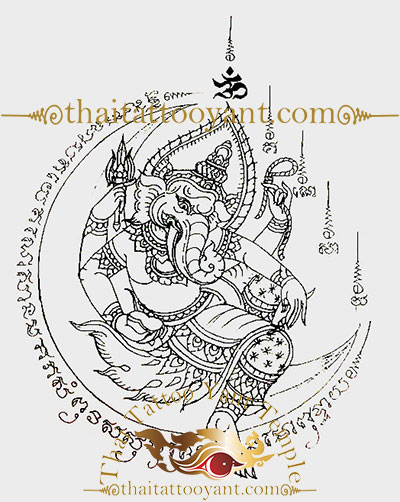
The Yant Ganesha, also known as Yant Phra Phikanet, is a sacred and highly auspicious design in traditional Thai Sak Yant tattooing.
Ganesha (Phra Phikanet in Thai) is the beloved Hindu-Buddhist deity widely revered as the Remover of Obstacles, the God of Success, and the Patron of Wisdom and New Beginnings. He is depicted with an elephant head, a large belly, and multiple arms, symbolizing intelligence, strength, and the ability to clear the path for prosperity and achievement.
In Sak Yant tradition, this Yant invokes Ganesha’s divine blessings to help the wearer overcome difficulties, gain favorable outcomes, and move forward smoothly in life.
Spiritual Meaning and Benefits
Wearing the Yant Ganesha is believed to grant:
Removal of Obstacles — Clears away barriers, problems, and difficulties in career, business, relationships, and personal goals.
Success and Prosperity — Strong attraction of good fortune, wealth, business success, and achievement in all endeavors.
Wisdom and Intelligence — Enhanced intellect, sharp decision-making, creative problem-solving, and strategic thinking.
Protection and Good Luck — Safeguarding from misfortune, accidents, and negative energies while bringing auspicious blessings.
New Beginnings and Harmony — Support for starting new projects, journeys, or chapters in life with smooth progress and positive energy.
Kindness and Popularity — Increased metta (loving-kindness), charm, and the ability to gain goodwill and support from others.
This Yant is especially popular among entrepreneurs, business owners, students, artists, writers, and anyone beginning new ventures or facing challenges that require clever solutions. It is considered an excellent all-rounder for success, wisdom, and gentle yet effective protection.
The design typically features the iconic figure of Ganesha in a seated or standing pose, often holding symbolic objects (such as a lotus, axe, or sweets), with sacred Khom script (Akara) integrated around or within the image for added spiritual power. Its warm and benevolent presence makes it both visually beautiful and deeply meaningful.
Because of Ganesha’s universal appeal as the remover of obstacles and bringer of success, the Yant Ganesha remains one of the most loved and respected designs for those seeking smooth progress, wisdom, and divine support in their lives.
Sak Yant Thai Tattoo: Yant Hanuman Song Singha (Bamboo Tattoo Hanuman Riding Singha / Hanuman Tua Sib)
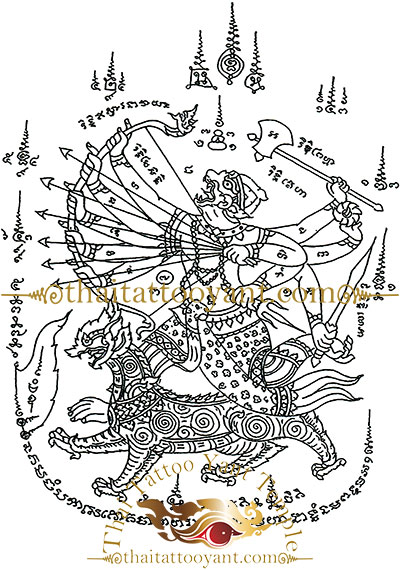
The Yant Hanuman Song Singha, also known as Hanuman Riding the Singha or Hanuman Tua Sib (the 10th Hanuman), is a rare and exceptionally powerful design in traditional Thai Sak Yant tattooing.
It depicts the legendary monkey god Hanuman — the devoted warrior from the Ramakien epic — fearlessly riding atop a Singha (a mythical lion-like creature symbolizing royal power, courage, and dominance). This combination merges Hanuman’s legendary attributes of loyalty, agility, strength, and unwavering devotion with the Singha’s commanding authority and majestic presence.
In Thai mythology, Hanuman is an unstoppable force who helped Lord Rama achieve victory through courage, intelligence, and self-sacrifice. Riding the Singha elevates this power further, representing the ultimate warrior who leads with both heart and supremacy.
Spiritual Meaning and Benefits
Wearing the Yant Hanuman Song Singha is believed to grant:
Fearless Courage and Strength — Unshakable bravery, physical and mental power, and the ability to face any challenge or enemy without hesitation.
Authority and Leadership — A commanding presence that earns respect, dominance, and the ability to lead or influence others effectively.
Invulnerability and Protection — Strong safeguarding from danger, harm, weapons, accidents, black magic, and negative forces (Kong Krapan Chatri and Klaew Klaad).
Victory and Success — Triumph over obstacles, success in competition, battles (literal or metaphorical), and all endeavors.
Loyalty and Devotion — Enhanced faithfulness, determination, and the spiritual power that comes from selfless service and perseverance.
This Yant is especially popular among Muay Thai fighters, soldiers, athletes, leaders, and anyone seeking supreme warrior energy, protection in high-risk situations, or the drive to overcome major challenges. Because of its intensity and size, it is typically placed on larger areas such as the back or chest and is often considered suitable only above the waist.
The design usually shows Hanuman in a dynamic riding pose on the powerful Singha, surrounded by intricate sacred Khom script (Akara) that amplifies its potency. Its rare and majestic appearance makes it one of the most respected high-level Yants for those desiring ultimate power, fearlessness, and divine guardianship.
Sak Yant Thai Tattoo: Yant Jing Jok (Bamboo Tattoo Gecko Yant)
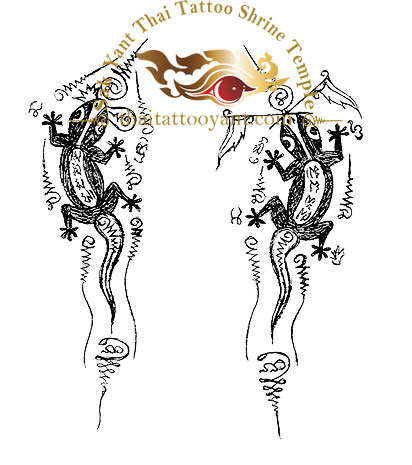
The Yant Jing Jok, also known as the Gecko Yantra, is a popular and highly auspicious design in traditional Thai Sak Yant tattooing.
In Thai culture, the gecko (Jing Jok) is considered a lucky creature. Its distinctive call is believed to bring good news, and its ability to climb walls effortlessly symbolizes adaptability, agility, and the power to thrive in any environment. The gecko is also known for its regenerative abilities — it can regrow its tail if lost — making it a strong symbol of resilience, renewal, and survival.
This Yant is often chosen for its gentle yet effective energy, balancing protection with charm and good fortune.
Spiritual Meaning and Benefits
Wearing the Yant Jing Jok is believed to grant:
Good Luck and Auspiciousness — Strong attraction of positive opportunities, favorable outcomes, and daily blessings. Many believe hearing a gecko call after receiving this Yant signals incoming good news.
Charm and Popularity (Metta Mahaniyom) — Enhanced personal magnetism, likability, and the ability to win people’s hearts and support.
Adaptability and Agility — The power to navigate challenges smoothly, adjust quickly to new situations, and move through life with ease.
Protection and Resilience — Safeguarding from minor dangers, accidents, and negative energies, plus the ability to recover quickly from setbacks.
Prosperity and Success — Support for business dealings, negotiations, sales, and overall growth in career or personal life.
This Yant is especially popular among salespeople, entrepreneurs, public-facing professionals, travelers, and anyone who wants to attract luck, charm, and smooth progress in daily life. It is considered a lighter, more approachable Yant compared to fierce animal designs like tigers or crocodiles, yet still carries strong spiritual power.
The design typically features a realistic or stylized gecko with its characteristic spotted body and wide toes, often climbing upward, combined with sacred Khom script (Akara) for added potency. Some versions include twin geckos for doubled luck and protection.
Because of its friendly reputation and proven track record for bringing good fortune and likability, the Yant Jing Jok remains a favorite choice for those seeking positive energy, adaptability, and everyday blessings.
Sak Yant Thai Tattoo: Yant Pra Laks Hnaa Tong (Bamboo Tattoo Golden Face Lakshmana Yant)
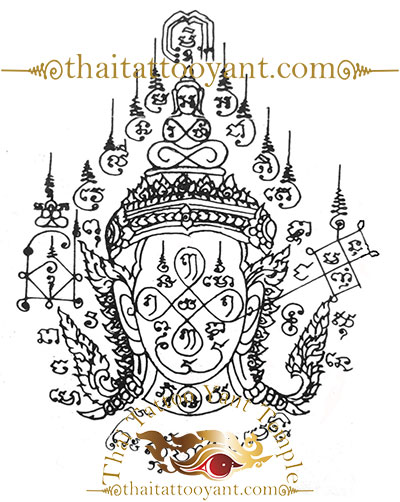
The Yant Pra Laks Hnaa Tong, also known as Yant Phra Lak Na Thong or Golden Face Yantra, is a highly auspicious and charismatic design in traditional Thai Sak Yant tattooing.
“Pra Laks” refers to Phra Lak (Lakshmana), the loyal younger brother of Lord Rama in the Ramakien (Thai version of the Ramayana epic). “Hnaa Tong” means “Golden Face,” symbolizing radiant beauty, divine grace, and an irresistibly attractive presence. This Yant represents the golden-faced Lakshmana, embodying mercy, charm, and the power to win hearts effortlessly.
It is considered a powerful Metta Mahaniyom (loving-kindness and popularity) Yant, often chosen by those who wish to shine socially and professionally while receiving widespread goodwill.
Spiritual Meaning and Benefits
Wearing the Yant Pra Laks Hnaa Tong is believed to grant:
Charm and Popularity — Exceptional personal magnetism, likability, and the ability to be loved and respected by everyone around you.
Persuasion and Harmony — The power to make others see things from your perspective, smooth interpersonal relationships, and win favor in negotiations, sales, or leadership roles.
Love and Compassion — Attraction of affection, mercy, and positive connections in romance, friendships, family, and work.
Wealth and Prosperity — Strong influence on financial success, business growth, promotions, and overall good fortune.
Protection from Illness and Misfortune — Safeguarding against sickness, bad luck, and negative energies, while containing 108 kinds of blessings for holistic well-being.
This Yant is especially popular among entrepreneurs, salespeople, public figures, performers, and anyone in customer-facing or leadership positions. It excels in enhancing social success, business dealings, and personal relationships while maintaining a gentle, positive energy.
The design typically features a radiant, golden-faced figure (often stylized as Phra Lak) with serene yet commanding features, surrounded by sacred Khom script (Akara) that amplifies its power of attraction and protection. Some versions are more abstract, focusing on the glowing face and yantra elements.
Because of its reputation for bringing widespread love, respect, and prosperity, the Yant Pra Laks Hnaa Tong is one of the most sought-after designs for those seeking to live with grace, influence, and abundant blessings.
Sak Yant Thai Tattoo: Yant Kilane Singha (Bamboo Tattoo Ki Lane Singha / Mythical Lion Yant)
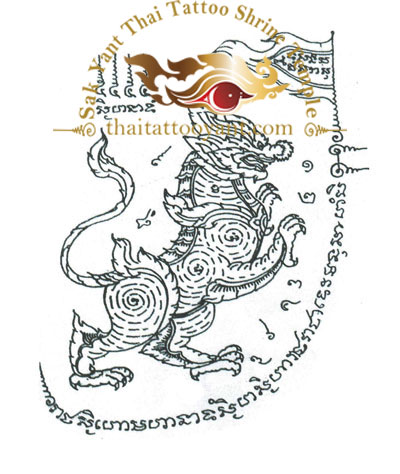
The Yant Kilane Singha, also known as Yant Ki Lane Singha or Yant Singha, is a powerful and regal design in traditional Thai Sak Yant tattooing.
“Kilane” (or Ki Lane) refers to the mythical Singha — a majestic, lion-like creature from Thai and Himmapan forest mythology. The Singha is revered as the King of Lions, symbolizing supreme authority, courage, nobility, and unshakeable strength. In ancient lore, it serves as a guardian and protector, commanding respect and instilling fear in enemies while radiating charisma and leadership.
This Yant channels the Singha’s royal energy, making the wearer appear dominant, confident, and protected — much like a lion that rules the jungle with natural power and dignity.
Spiritual Meaning and Benefits
Wearing the Yant Kilane Singha is believed to grant:
Immense Strength and Courage — Unbreakable inner power, bravery, and the ability to face any challenge or adversary without fear.
Authority and Leadership — A commanding presence that earns deep respect, influence, and recognition as a natural leader.
Protection and Invulnerability — Strong safeguarding from danger, harm, weapons, accidents, evil forces, and misfortune.
Charm and Charisma — Enhanced personal magnetism, popularity, and the ability to dominate situations while winning goodwill (Metta Mahaniyom).
Victory and Success — Triumph over obstacles, success in competition, career, or battle (literal or metaphorical), and overall dominance in life.
This Yant is especially popular among Muay Thai fighters, soldiers, law enforcement, leaders, entrepreneurs, and anyone seeking to project power, gain respect, or rise to positions of authority. Some versions include the Singha carrying a flag (Singha Thong Chai), adding the meaning of victory and immortal strength.
The design typically features a fierce yet noble mythical lion in a dynamic or standing pose, often with flowing mane, sharp features, and integrated sacred Khom script (Akara) for maximum potency. Twin Singha versions amplify the power even further.
Because of its royal symbolism and reputation for bestowing king-like presence and protection, the Yant Kilane Singha remains one of the most respected designs for those desiring strength, leadership, and unyielding dominance in life.
Sak Yant Thai Tattoo: Yant Ohm (Bamboo Tattoo Om / Aum Yant)
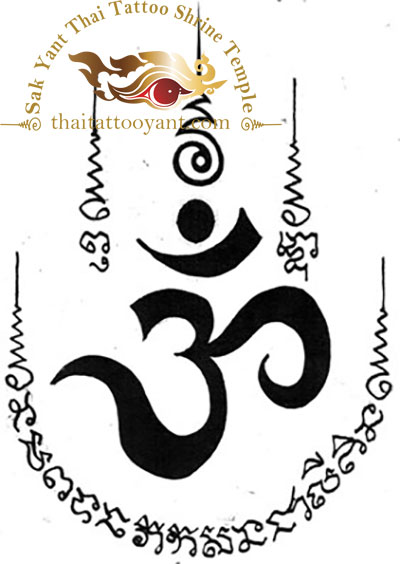
The Yant Ohm, also known as the Om Yantra or Aum Yant, is a sacred and spiritually profound design in traditional Thai Sak Yant tattooing.
“Ohm” (or Om / ॐ) is the ancient Sanskrit mantra representing the primordial sound of the universe — the vibration from which all creation, preservation, and transformation arise. In Thai Sak Yant, it is often combined with other elements such as the Hah Taew (Five Lines), lotus flowers, or protective Khom script, blending Hindu-Buddhist cosmology with Thai esoteric power.
This Yant symbolizes the connection between the individual soul and the divine, bringing inner harmony, cosmic balance, and elevated spiritual energy.
Spiritual Meaning and Benefits
Wearing the Yant Ohm is believed to grant:
Spiritual Awakening and Inner Peace — Deep connection to higher consciousness, mental clarity, emotional balance, and harmony between body, mind, and soul.
Protection and Mental Strength — Strong shielding from negative energies, black magic, enemies, and inner turmoil. It provides courage and mental fortitude (some versions, like Yant Ohm Khan Satru, specifically protect against adversaries).
Success and Good Fortune — Attraction of overall success, prosperity, good luck, and the removal of obstacles on one’s path.
Charm and Loving-Kindness — Enhanced metta (compassion), personal magnetism, and positive relationships.
Universal Blessings — When combined with other Yants (such as the Five Rows), it amplifies protection, wealth, health, popularity, and spiritual power.
This Yant is especially popular among those seeking spiritual growth, inner strength, meditation practice, or a balanced combination of protection and personal development. It is favored by practitioners, business people, fighters, and anyone wanting divine energy and harmony in daily life.
The design typically features the sacred Ohm symbol (ॐ) prominently, often integrated with flowing Khom script (Akara), geometric yantra patterns, or accompanying motifs like lotuses for purity and enlightenment. Its elegant and mystical appearance makes it both visually powerful and deeply meaningful.
Because of its universal sacred nature and ability to connect the wearer to cosmic energy, the Yant Ohm remains a respected choice for those desiring spiritual elevation alongside practical blessings of protection and success.
Sak Yant Thai Tattoo: Yant Pho Ngang Maha Sane (Bamboo Tattoo Pho Ngang Great Charm Yant)
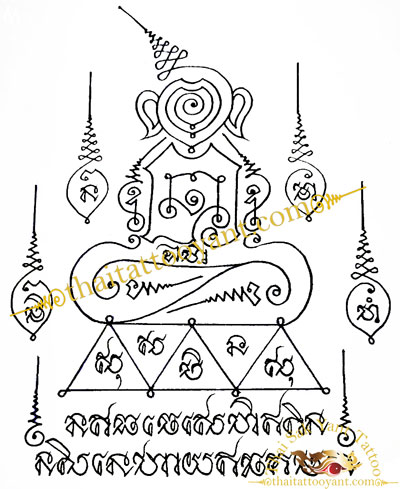
The Yant Pho Ngang Maha Sane, also known as Yant Phra Ngang Maha Sanae, is a potent and highly attractive design in traditional Thai Sak Yant tattooing, focused on charm and magnetic energy.
“Pho Ngang” (or Phra Ngang) refers to a revered mystical figure rooted in Khmer-influenced Thai esoteric tradition — often depicted as a charismatic, sometimes one-eyed or enigmatic spiritual being associated with attraction, influence, and benevolent power. “Maha Sane” (Maha Sanae) means “Great Charm” or “Great Attraction,” making this Yant a classic Maha Sanae design dedicated to enhancing personal magnetism and persuasive power.
This Yant is deeply tied to the power of metta (loving-kindness) and the ability to draw people in with ease and goodwill.
Spiritual Meaning and Benefits
Wearing the Yant Pho Ngang Maha Sane is believed to grant:
Powerful Charm and Attraction (Maha Sanae) — Exceptional personal magnetism that makes the wearer more likable, persuasive, and attractive to others in love, romance, and social situations.
Popularity and Metta Mahaniyom — The ability to win hearts, gain favor, and receive kindness, support, and preferential treatment from people.
Success in Persuasion and Communication — Enhanced eloquence and influence, ideal for sales, negotiations, public speaking, interviews, or any situation requiring smooth interpersonal dealings.
Good Fortune and Opportunities — Attraction of positive relationships, romantic success, business advantages, and overall auspicious energy.
Gentle Protection — Subtle shielding from negativity while promoting harmony and emotional balance.
This Yant is especially popular among singers, performers, salespeople, entrepreneurs, public figures, and anyone seeking greater success in relationships, career, or social circles. It is considered an excellent choice for those who want to shine through charm rather than force, while maintaining a positive and respectful presence.
The design typically features a stylized, mystical Pho Ngang figure (sometimes with a serene or charismatic expression), often combined with sacred Khom script (Akara), lotus elements, or radiating lines that symbolize glowing attraction and divine energy.
Because of its strong reputation for boosting likability, love, and persuasive power, the Yant Pho Ngang Maha Sane remains a favorite Maha Sanae design for those desiring magnetic success and harmonious connections in life.
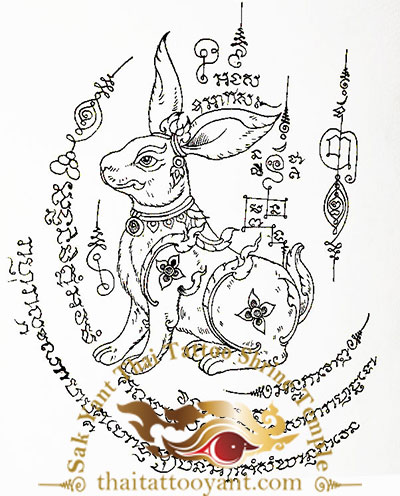
Sak Yant Thai Tattoo: Rabbit Yant (Bamboo Tattoo Yant Rabbit)
Rahu, Garuda and Vishnu Sak Yant (Bamboo Tattoo Yant)
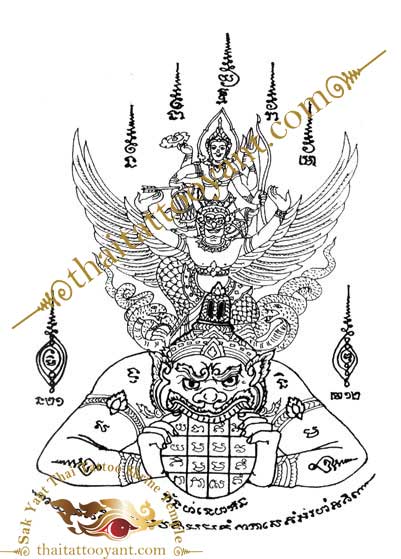
Rahu, Garuda, and Vishnu Sak Yant (most commonly known as Yant Phra Narai Song Krut or Phra Narai Song Khrut) is a powerful, high-level Thai sacred tattoo design drawn from Hindu-Buddhist mythology (Ramakien and the Churning of the Ocean of Milk). It depicts Phra Narai (Vishnu, the preserver god) riding or standing upon Garuda (Khrut, the king of birds and Vishnu’s divine vehicle), who in turn dominates or stands over Phra Rahu (the immortal head of the eclipse demon, also called the Moon-Eater or Lord of Darkness).
Visual Composition
Top: Phra Narai (Vishnu) in his warrior form, often multi-armed, holding weapons like the chakra (spinning disc), bow, arrow, or conch.
Middle: Garuda — a majestic half-man, half-eagle figure with powerful wings, talons, and a fierce beak. Garuda and the naga (serpents) are mortal enemies (half-brothers from mythology), so nagas are sometimes shown being subdued by Garuda.
Bottom: Phra Rahu — typically shown as a fierce, dark, demonic upper body (sometimes with a tail or swallowing an orb representing the moon/sun). Rahu is under the control of the divine pair above.
Surrounding elements: Khom (ancient Khmer) script with sacred mantras (kata), geometric yantra patterns, flames, or protective symbols.
This creates a hierarchical scene of divine order triumphing over chaos.
Mythological Background
During the churning of the ocean for the immortal nectar (Amrit), Phra Rahu disguised himself to drink it. Phra Narai discovered the deception, cut Rahu in half with his discus. The immortal head of Rahu seeks revenge by “eating” the sun and moon — causing eclipses. Garuda assists Vishnu in battles against demons and nagas. The yant symbolizes the gods’ victory: light and order conquering darkness and disruption.
Meanings and Powers
This Sak Yant is considered one of the stronger “Maha Yant” (great yantras) and carries blessings such as:
Great power, authority, and prestige — Enhances leadership, charisma, and influence (popular with officials, military, or business leaders).
Protection from harm — Especially against black magic, evil spirits, enemies, accidents, and “unseen” negative forces.
Transformation of misfortune — Rahu’s chaotic energy (bad luck, obstacles, eclipses) is subdued and reversed into good fortune, success, and renewal.
Victory over obstacles — Helps remove blocks in career, life, or spiritual path; brings progress, prosperity, and resilience.
Additional benefits often include courage, invincibility, wealth attraction, and balance between light/dark forces.
It represents divine control over darkness — turning potential harm into strength and opportunity.
Ruesi Sak Yant (also called Yant Ruesi, Yant Lersi, or Hermit Sage Yantra) Bamboo Tattoo Thailand
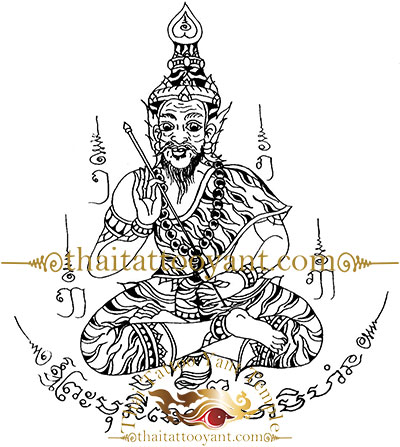
is a sacred Thai tattoo design that invokes the spirit and powers of the Ruesi (Rishi or Lersi) — ancient hermit sages, ascetics, and mystical practitioners from pre-Buddhist Brahmin traditions.
Ruesi were forest-dwelling wise men who practiced intense meditation, self-discipline, alchemy, herbal healing, and spiritual arts. They created yantras (sacred diagrams) to harness hidden powers for protection, wisdom, and guidance. In Sak Yant, this yant channels their energy as a spiritual teacher and guardian.
Core Meanings and Powers
The Yant Ruesi bestows:
Wisdom and Insight — Sharpens intellect, spiritual understanding, and clarity of mind.
Guidance and Protection — Acts like a lifelong mentor, shielding from life’s obstacles, negative energies, and harm.
Calmness and Serenity — Promotes inner peace, aids meditation, and helps maintain tranquility amid chaos.
Spiritual Growth — Encourages detachment from material attachments, ethical living, and higher consciousness.
Additional benefits often include good luck in endeavors, resilience, healing energies, and support during difficult times (e.g., career lows or personal challenges).
It is especially popular among those seeking personal development, teachers, healers, artists, or anyone wanting a “spiritual anchor” rather than raw power (like tiger yants) or dominance (like Narai/Garuda designs). Some variants, such as those linked to Pu Ruesi Narod (a revered hermit figure), emphasize lineage, white magic, and ancestral knowledge.
Ruesi appear in various forms: some are wise elders with beards, others tiger-faced (Na Seua) for strength and courage, or warrior sages. Designs may feature a stylized Ruesi figure (often bearded hermit with staff or in meditation pose), surrounded by Khom script mantras, geometric yantra patterns, flames, or symbolic elements like mountains/caves representing their ascetic life.
Scorpion Sak Yant (Bamboo Tattoo Thailand)
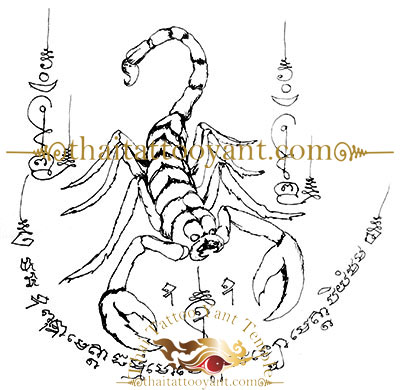
(Thai: Yant Maeng Pong or Yant Mang Pong — ยันต์แมงป่อง) is a traditional animal-themed sacred tattoo that channels the fierce, defensive, and transformative qualities of the scorpion. It is less common than tiger (Suea) or dragon (Mangkorn) yants but is chosen for its potent protective and strategic energy.
Symbolism and Mythology
In Thai influenced traditions, the scorpion represents survival in harsh environments, quick strikes against threats, and the ability to transform poison (adversity) into strength. It draws from animist beliefs blended with Buddhist and Brahmanical elements — the scorpion becomes a personal guardian that “stings” back at danger, enemies, or misfortune. Some interpretations link it to the power of transformation and resilience, similar to how a scorpion sheds its exoskeleton or survives extreme conditions.
Meanings and Powers
This yant is believed to grant:
Strong protection against adversaries, black magic, accidents, and misfortune.
Enhanced personal strength, determination, and resilience — “small but mighty” energy.
Heightened alertness, strategic thinking, and quick reflexes (ideal for high-pressure situations like business negotiations, competitive fields, or risky professions).
Good fortune in endeavors, especially business success and turning challenges into opportunities.
Overall: It acts as an amuletic shield, binding ancestral wisdom and unwavering fortitude.
Designs often include:
A single coiled scorpion poised to strike (immediate defense).
Twin scorpions (mutual/shared protection).
Scorpion combined with floral elements (e.g., lotus for purity balancing ferocity) or geometric/Khom script for added layers.
Surrounding sacred Khom mantras that activate the specific virtues.
See No Evil, Speak No Evil, Hear No Evil Sak Yant (Bamboo Tattoo Yant)
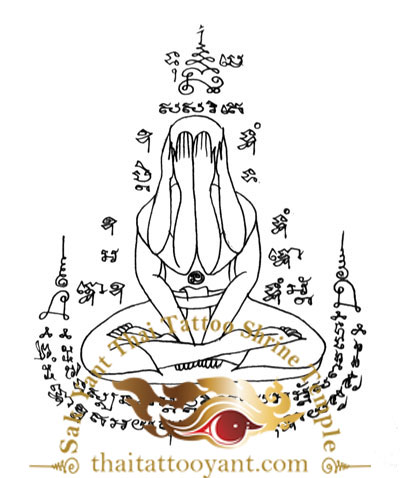
(often called Yant See-Hear-Speak No Evil or the Three Wise Monkeys Yant) is a modern or adapted Sak Yant design inspired by the famous Japanese proverb of the Three Wise Monkeys (Mizaru, Kikazaru, Iwazaru). It symbolizes avoiding evil by not seeing it, not hearing it, and not speaking it — promoting purity of mind, ethical living, and inner peace.
Meaning and Powers
This yant represents:
Mental and spiritual protection — Shielding the wearer from negative influences, gossip, toxic environments, or evil intentions around them.
Maintaining a clear and positive state of mind — Not letting external negativity affect one’s thoughts, words, or actions.
Ethical guidance — Encourages living virtuously; if you have the power to positively change or stop evil, you should act — but otherwise, do not engage with it.
Additional blessings often include calmness, wisdom, good karma, and resilience against black magic or bad luck.
In traditional Sak Yant, it is sometimes described as helping the bearer remain unaffected by surrounding evil while staying aligned with Buddhist principles of right thought, speech, and action. It fits well in the broader theme of protection and moral strength.
Design Elements
Typically features three monkey figures (or stylized versions): one covering eyes (see no evil), one covering ears (hear no evil), one covering mouth (speak no evil).
Integrated with Khom script, sacred mantras (kata), geometric yantra patterns, or Buddhist symbols like lotus flowers (purity) for added power.
Some versions show a Buddha in lotus pose surrounded by or incorporating the three monkeys motif.
Can be realistic, stylized, or blended with skulls/other elements in modern interpretations.
Phra Ta Nark Twin Snakes Sak Yant (Bamboo Tattoo Yant)
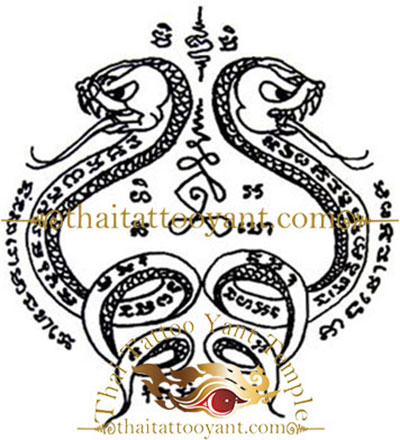
(also known as Yant Phra Ta Nark, Yant Naga Koo, or Twin Naga Yant) is a powerful animal-themed sacred tattoo featuring two mirroring or intertwined Naga (mythical serpent-dragons). “Phra Ta Nark” (or Phra Thanak) refers to the revered Naga serpent in Thai lore — a guardian of waterways, hidden treasures, fertility, and sacred knowledge.
Symbolism and Mythology
Nagas originate from Hindu-Buddhist and animist traditions. They are semi-divine beings that live in water and underground realms, often depicted as cobras or multi-headed serpents. In Sak Yant, the Naga embodies renewal (shedding skin), wisdom, intuition, and guardianship. The twin version (Koo) adds balance, unity, and mutual strength — like yin-yang harmony or paired guardians.
The design typically shows:
Two symmetrical or intertwined Nagas (often with flared hoods, scales, and flowing bodies).
Surrounded by Khom script with protective mantras (kata).
Geometric elements or flames for added power.
Twin snakes may appear coiled together, facing each other, or in a mirrored pose.
Meanings and Powers
This yant is believed to provide:
Protection — Strong shielding for body and mind against negative energies, enemies, accidents, and misfortune. The twin aspect offers “dual” or mutual guardianship.
Transformation and renewal — Like a snake shedding its skin, it helps you release the old and embrace change, rebirth, and personal growth.
Wealth, fortune, and charm — Attracts prosperity, good luck in business/money, popularity, and metta (loving-kindness). It can enhance relationships, reconciliation, and social influence.
Wisdom and intuition — Sharpens perception, inner strength, and spiritual guidance; useful for navigating challenges smoothly.
Balance and unity — Strengthens love/relationships (symbolizing intertwined unity), authority, charisma, and karmic power. Some interpretations add resilience, quick adaptation, and zest for life.
Sak Yant Thai Tattoo: Yant Maeng Mum (Bamboo Tattoo Spider Yant)
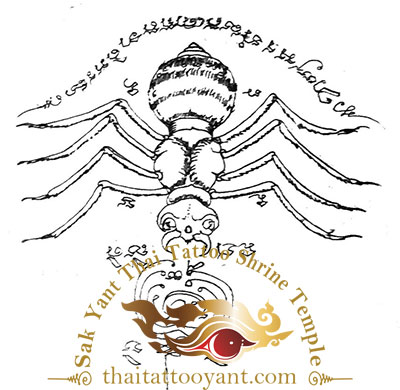
The Yant Maeng Mum, also known as the Spider Yantra (ยันต์แมงมุม or Yant Maeng Mum Dak Sap), is a strategic and auspicious design in traditional Thai Sak Yant tattooing.
In Thai, “Maeng Mum” means spider — a creature admired for its patience, intricate web-weaving, precision, and ability to attract and trap what it needs. The spider patiently builds its web to catch prey and opportunities, symbolizing clever strategy, attraction of fortune, and protection through intelligent structure rather than force.
This Yant draws from Thai animism and ancient Saiyasart (esoteric knowledge). It is considered one of the more subtle yet highly effective animal Yants, often chosen by those seeking to attract wealth and success effortlessly, develop strategic thinking, and create a “net” that holds good fortune while filtering out negativity.
Spiritual Meaning and Benefits
Wearing the Yant Maeng Mum is believed to grant:
Attraction and Retention of Good Fortune — Like a finely woven web that catches luck, opportunities, wealth, and prosperity while allowing negativity to pass through. It helps “trap” success, money, and beneficial connections that come your way.
Patience, Strategy, and Intelligence — The power of careful planning, thinking before acting, and waiting for the right moment. It supports wise decision-making and long-term success through cleverness rather than haste.
Protection Through Structure — A defensive energy that wards off danger, bad intentions, and unwanted influences. The web acts as a boundary, protecting the wearer while drawing in positive energies.
Opportunity Capture and Magnetism — The ability to draw opportunities, clients, customers, and good luck naturally without chasing them. Ideal for business, sales, networking, and situations requiring persuasion or attraction.
Skillful Creation and Resilience — Turning disciplined effort into tangible results, with the beauty and strength built from focus and persistence. It also symbolizes renewal and adaptability.
This Yant is especially popular among business owners, entrepreneurs, salespeople, negotiators, artists, and anyone in competitive or creative fields who wants success to flow toward them. It is often regarded as a high-level design for those seeking intelligent attraction, strategic protection, and prosperous growth without unnecessary struggle.
The design typically features a stylized spider with its web, detailed legs, and sometimes a central body integrated with sacred script that activates and personalizes its spiritual potency. Some versions emphasize the web for stronger attraction or show the spider in an active, trapping pose.
Because of its reputation for delivering patient strategy, magnetic fortune, clever protection, and effortless opportunity, the Yant Maeng Mum remains a respected animal Yant for those seeking to weave success and stability into their lives through wisdom and precision.
Square Yant Maha Sawang (Bamboo Tattoo Yant)
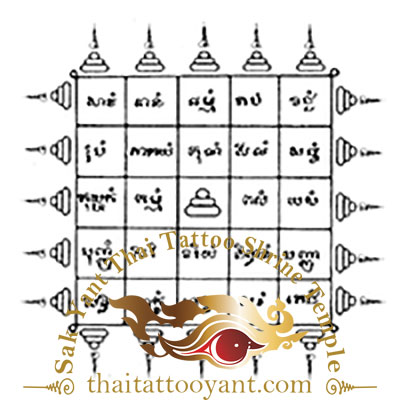
(ยันต์มหาสว่าง — “Great Light” or “Great Illumination” Yantra) is a traditional Sak Yant design known for its powerful healing, protective, and charm qualities. “Maha” means great/large, and “Sawang” means bright light or radiance, symbolizing divine illumination that dispels darkness, illness, and danger.
Meanings and Powers
This yant is believed to:
Cure all diseases and heal the body/mind — It brings “great light” to overcome sickness, weakness, and physical/spiritual ailments.
Protect from all dangers — Shields against accidents, harm, evil spirits, ghosts, demons, black magic, and misfortune.
Attract love and popularity — Acts as a metta (loving-kindness) charm that makes people like, respect, and feel drawn to the wearer (similar to Maha Saneh or Maha Niyom effects).
Bring overall radiance and good fortune — Enhances inner brightness, clarity, success, and positive energy in life.
It is often grouped with or placed near other powerful yantras like Maha Ud (invulnerability, mercy, great popularity) and Maha Niyom (belief, favor from others). Some descriptions position it as part of broader “Yantra Baramee Buddha” (Buddha’s merit yantras), emphasizing enlightenment-like qualities.
Design Style
Yant Maha Sawang is typically a geometric/yantra-style design featuring intricate Khom (ancient Khmer) script, sacred symbols, circles, squares, or radiating patterns that evoke light and energy. It may include Buddha elements, lotus motifs, or mantras invoking illumination and protection. Like most Sak Yants, it is hand-tapped with bamboo/steel rods by an Ajarn, accompanied by chanting (kata) and a blessing ritual.
Sak Yant Thai Tattoo: Yant Payanag (Nagaraj / Phaya Naga Bamboo Tattoo Yant)
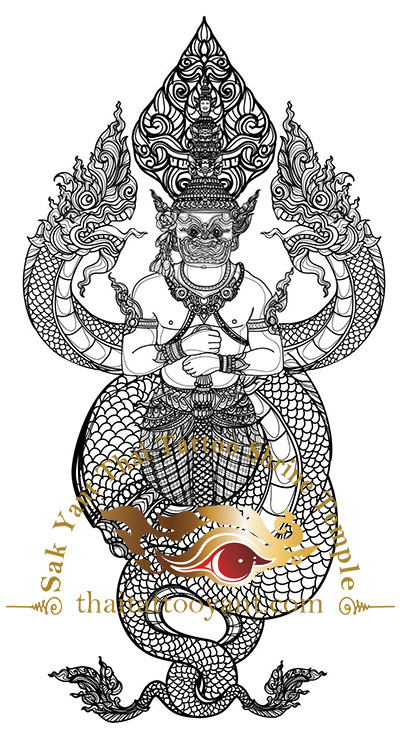
The Yant Payanag, also known as Yant Nagaraj or Phaya Naga Yantra, is a majestic and highly revered design in traditional Thai Sak Yant tattooing, especially popular in Lanna (Northern Thai) tradition.
“Payanag” (or Payanak) refers to the Great Naga — the mythical serpent king (Nagaraj) that features prominently in Buddhist, Hindu, and Thai folklore. The Naga is a powerful, semi-divine being associated with water, rain, fertility, and the protection of sacred teachings. It is often depicted as a multi-headed serpent or dragon-like creature that guards treasures, temples, and the Buddha himself (most famously sheltering the Buddha during a storm).
This Yant invokes the immense spiritual power of the Naga King, symbolizing the balance between earthly power and divine wisdom.
Spiritual Meaning and Benefits
Wearing the Yant Payanag is believed to grant:
Protection and Guardianship — Strong safeguarding from danger, harm, accidents, black magic, and negative energies. The Naga acts as a fierce protector for the wearer.
Wealth and Prosperity — Attraction of abundance, good fortune, unexpected luck, and material success. The Naga is traditionally a guardian of hidden treasures and riches.
Power and Strength — Inner and outer power, resilience, and authority, especially in challenging situations.
Wisdom and Intuition — Heightened spiritual insight, emotional balance, intuition, and connection to higher realms or sacred knowledge.
Purification and Transformation — Cleansing of negative influences, personal growth, regeneration, and the ability to flow gracefully through life’s changes (like water).
Peace and Good Fortune — A harmonious life filled with happiness, popularity, and blessings wherever one goes.
The design is often intricate, featuring a majestic Naga (sometimes multi-headed) coiled or rising, combined with powerful Khom script (Akara) and sacred yantra elements for maximum potency. It is especially favored by those seeking success in business, spiritual growth, protection in risky professions, or a deeper connection to divine forces.
Because of its association with wealth, strength, and sacred protection, the Payanag Yant is considered one of the more potent designs for attracting both material and spiritual abundance while maintaining balance and responsibility.
Frog Sak Yant (Bamboo Tattoo Thailand Yant)
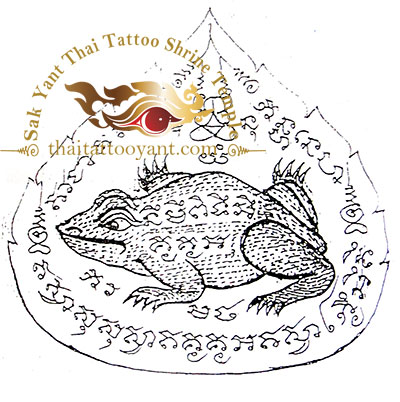
(Thai: Yant Kop or Yant Paya Kob; sometimes called Yant Khaasi) is a relatively uncommon but authentic animal-themed sacred tattoo. It draws from Thai animist traditions where the frog symbolizes life in transitional environments — between water and land, rain and drought, stagnation and flow.
Symbolism and Powers
Frogs represent renewal (their life cycle from egg → tadpole → adult), adaptability (thriving in changing conditions), fertility/abundance (linked to rain and fertile wetlands), cleansing (indicating a healthy ecosystem), and opportunity (the “flow” of good fortune). The frog’s loud call also ties into voice, influence, and reputation.
This yant is believed to grant:
Luck, wealth & prosperity — Attracts money, good opportunities, business success, and abundance.
Adaptability & transformation — Helps navigate life changes, rebirth, and personal growth with grace.
Fertility & abundance — Supports creative projects, relationships, or literal fertility.
Protection & cleansing — Wards off negative energy, stagnation, misfortune, and bad influences.
Kindness, compassion & metta — In some lineages, it promotes a gentle, attractive presence and being “heard” positively.
It suits people in transition (career moves, relocations), creatives, entrepreneurs, traders, healers, or anyone seeking renewal and flow rather than raw power (like tigers or crocodiles).
Turtle Sak Yant (Bamboo Tattoo Thailand Yant)
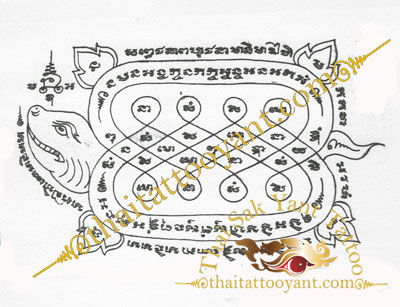
(Thai: Yant Tao or more commonly Yant Dtao Ruen / Phraya Tao Ruean — ยันต์เต่าเรือน or พญาเต่าเรือน) is a classic Himpant animal sacred tattoo. “Dtao Ruen” means “Turtle House” because legend says the Buddha was once reincarnated as a giant turtle whose shell grew as large as a house.
Symbolism and Mythology
The turtle links to the earth element (stability, patience) and water (flow, adaptability). In Thai-Buddhist lore, it embodies longevity, non-violence, and gentle strength. Its hard shell offers unbreakable defense, while its slippery nature provides escape from danger (klaew klaad). It also carries feminine qualities like healing, emotional balance, and respecting boundaries.
Meanings and Powers
This yant is highly regarded for steady, long-term blessings:
- Long life, good health, and longevity — Thanks to the turtle’s natural lifespan.
- Wealth, prosperity, and good fortune (Maha Lap) — Attracts money, business success, and abundance.
- Protection — Kong grapan (invulnerability/hard shell) and klaew klaad (slipperiness/avoiding harm); shields from accidents, enemies, and misfortune.
- Luck and metta — Brings kindness, popularity, and a pleasant, non-aggressive presence.
- Emotional healing and stability — Helps reduce suffering, build patience, and navigate life’s changes with calm resilience.
- Additional benefits often include resourcefulness, independence, healing diseases, and smooth journeys (especially in business or travel).
It is considered one of the best yants for overall life stability and is popular with business people, healers, and those seeking enduring success rather than short-term power.
Unalome Sak Yant (Bamboo Tattoo Thailand Yant)
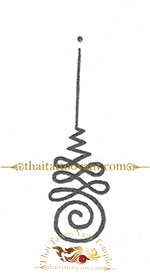
(also called Yant Unalome or simply the Unalome within Sak Yant designs)
is one of the most spiritually significant elements in traditional Thai sacred tattoos. It is not always a standalone yant but a core symbolic component that appears at the top of many Sak Yant designs (including Gao Yord, Hah Taew, and others).
Meaning and Symbolism
The Unalome represents the path to enlightenment in Buddhist tradition, especially as adapted in Thai Sak Yant:
The spiral / loops at the base: The twists and turns of life — confusion, struggles, karma, distractions, and the winding journey through samsara (the cycle of birth and rebirth). It reflects how we often go in circles due to desires, anger, or external influences.
The straightening line upward: As one progresses on the spiritual path, the mind unravels these fetters (desires and illusions). The path becomes straighter, more direct, and unwavering.
The final straight line or dot: Reaching enlightenment (Nirvana) — clarity, pure consciousness, freedom from suffering, and alignment with the divine. It symbolizes the state of an Arahant (enlightened being) or the Buddha’s path.
In Sak Yant context, the Unalome is often described as representing the crown of the head of the Buddha or the third eye/urna. It strengthens the overall power of the tattoo, adding spiritual guidance, protection, and a reminder of personal growth. Many Ajarns include it to invoke good luck, success, and protection from evil while guiding the wearer toward a more enlightened life.
Bamboo Tattoo vs Machine Tattoo
Major differences:
Bamboo Tattoo
Manual tapping with bamboo rod
Quieter, more meditative
Heals a lot faster due to less damage to the skin
Normal 3 days skin heals
More traditional and spiritual
Machine Tattoo
Electric machine
Louder, mechanical
Healing time a lot longer with scabbing
More modern and stylistic
Safety: Are Bamboo Tattoos Thailand Safe?
Bamboo tattoos are just as safe as machine tattoos if the correct hygiene standards are followed. Always ensure:
Fresh, sterile needles (never reused)
Clean environment
Reputable practitioner
Risks such as infection or transmission of diseases occur mainly when studios reuse needles or don’t follow hygiene protocols.
If you do decide to receive a Sak Yant bamboo design Thailand:
Try to choose a reputable and trusted provider with plenty of experience.
Ensure they have real Sak Yant masters and not monks. Monks are not permitted by strict Thai laws to administer Sak Yant designs to people. In fact, they are banned from doing so.
Naturally, most travelers prefer a vetted service which you can find online for the best and safer experiences.
The Reasons Why People Choose Bamboo Tattoo Thailand
Aesthetic uniqueness
Faster healing and minimal scabbing
Cultural and spiritual significance
More personal, quieter experience
Connection to Thai tradition
Now you have an insight into what the bamboo Thailand is all about, you should now feel more confident about receiving one! Good luck!
Social Media Links
Bangkok Ink Tattoo Group Associates in Business
Sak Yant Tattoo Designs
Sak Yant Designs
Thai Tattoo Designs
Thai Tattoo Yant Designs
Tiger Web Geek, Website Design, Hosting, SEO, Marketing
Thai Tattoo Sak Yant UK Tours
Bangkok Ink Studio, Machine, Hand Poke Tattoos, Tattoo Removal, VIP Service to Ajarn Ohr
Tattoo School Thailand Bangkok
Asian Artifacts oneshopasia.com
Thai Tattoo Sak Yant USA
...
Skindiver Tattoo Studio, Gothenburg, Sweden
inktattoo.se Tattoo Studio
Skin Graffiti Tattoo Studio UK
Happysailortattoo.com Old School Tattooing
Ink Tattoo Studio
jourservice
The Tattooed Gent Studio